
Guide · Buses
When a road is blocked: diverting buses.
A crash, roadworks or an event closes part of a busy bus corridor. What should the buses do?
What a blocked road does
Buses on the affected routes stop or crawl. Passengers on board are stuck, stops past the blockage get no service, and the delay carries into every later trip those buses run.
The choice
Diverting around the blockage keeps buses moving but skips the stops on the closed stretch, and the way round may be slow too. Waiting keeps every stop served but can leave passengers stuck for a long time. The answer depends on how long the closure lasts and how much slower the way round is.
Diversion is a bus move. Trains run on fixed track, so the rail options are to hold, short-turn, or terminate and run empty.
The recovery moves
What a control room can do.
- DivertSend buses around the blocked stretch, and know which stops they will miss.
- Short-turnTurn buses back before the blockage so trips on the other side keep running.
- HoldKeep buses short of the blockage when it is about to clear.
- Leave itIf the closure is short, staying put can be better for passengers.
Where Headway fits
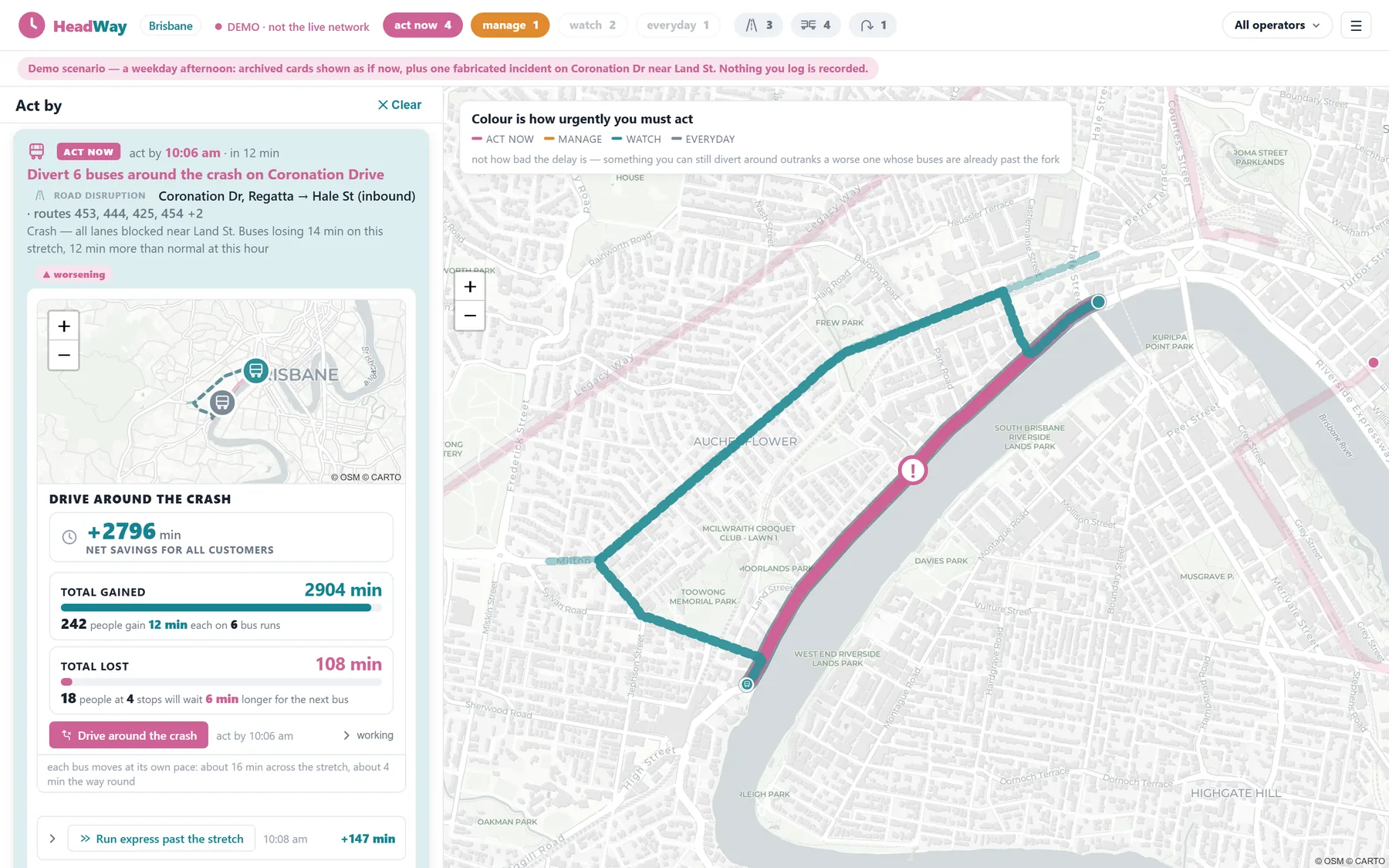
Headway shows the blocked stretch and the way round, and what a diversion does for passengers: the minutes gained and lost, and the time left to act.
It recommends; the controller decides. It does not dispatch, talk to drivers, set signals or plan timetables.
Questions
Is a diversion always the right answer?
No. If the closure is short or the way round is slow, waiting or turning buses short can be better for passengers. Leaving it is always an option.
Can trains be diverted around a problem?
Not in the way buses can. Trains run on fixed track, so the usual options are to hold, short-turn, or terminate and run empty.